Why you should take your vacation days!

US employees get on average per year 9 days paid leave and 6 paid holidays – despite the fact that the US is the only advanced economy in the world that has no paid leave law. European workers, for comparison, get in minimum 20 days of paid leave in addition to paid holidays. In my native country Austria, workers can get even up to six weeks of paid leave plus 13 holidays.

In the US, full time employees and those with a higher income are more likely to get paid vacation days than part-time and low wage workers. And despite having on average only nine days of paid vacation, roughly a third of employees with vacation benefits don’t take all of the vacation days they receive. Many believe that management perceives it negatively if they take vacation. A typical fear in these days of high unemployment is that workers are afraid that they may get replaced if they don’t give 110 % and therefore they rather forego on the well deserved time-off. About 25% of those, who do take vacation, stay connected with their company by checking work email or taking phone calls from the office while on vacation. About one third of employees admitted in an Expedia.com survey that they feel guilty about taking time off.

They shouldn’t – because it’s not only in their own interest if they use their vacation days to relax and refresh. There’s also a benefit to the employer: Workers who don’t get a break will become exhausted and burned-out over time. They are no longer able to perform to their full potential. They are also at risk for depression and other health issues, which may end up to cost the company more than the vacation days. On the other hand, workers who come back after a break with new energy and new perspectives and ideas will be more productive.

Therefore, talk to your employer about your vacation needs and how the company can even benefit from it. Plan ahead and talk to your co-workers about your vacation. Ask a co-worker to cover for you if necessary and offer the same favor in return. Final advice: don’t take work with you and avoid checking emails. It’s quite unlikely that your office will fall apart just because you take a few days off.

And with these lines, I say “Good bye” for two weeks. I will be on vacation in Austria!

Christiane is a Life and Career Coach. She also teaches psychology at a community college in Massachusetts. You can reach her via her website http://www.coach4u.net or email her.
Measure your Job Satisfaction

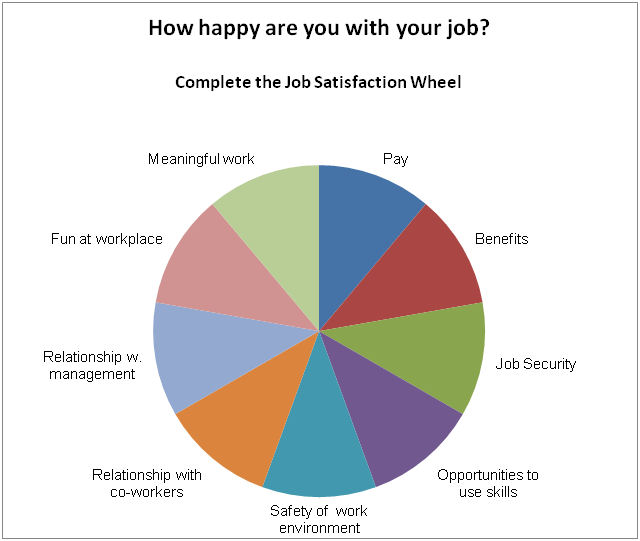
The ten sections of the Job Satisfaction Wheel represent important factors, which for many people determine job satisfaction.

 Print the wheel. Seeing the center of the wheel as 0 and the outer edges as 10, assign each section a value between 0 and 10, depending on YOUR satisfaction with the particular factor at YOUR current workplace. If you connect these values with a straight or curved line to create a new outer edge, do you still have a nice, round wheel?

 If you see areas that need improvement, take action. Don’t accept a dissatisfying job situation! Call me at 781 777 2791 or email me to schedule a Free Coaching introduction session to find out how Career Coaching can help you.

 Read also my e-workbook “Learn to Love your Job” with information and activities designed to help you to find satisfaction in your job. Learn more about the book.

Dissatisfied with your Job? Get “Learn to Love your Job”

Currently, job satisfaction is down to a record low in the US. About 55 % of Americans are unhappy with their work, according to a recent survey by the Conference Board research group.

Are you unhappy, too?

This eWorkbook will help you to identify strategies to get a satisfying job. “Learn to Love your Job” is not just a book to read. You will get 2 in 1, an eBook and an eCourse. “Learn to Love your Job” combines information with questions and self-tests about your own experiences and attitudes. You will also learn more about strategies to improve your job situation.

After reading the eWorkbook and doing the exercises, you will have a better understanding of your needs and what you are expecting from a job – besides a good salary, of course. You will know what makes you happy at your workplace and what triggers unhappiness.

After reading the eWorkbook “Learn to Love your Job” you will be able to answer among others the following questions:

• What are the 5 most important job satisfaction factors?

• How important are good relationships with co-workers for me? Do I have a strong need for building relationships with co-workers and/or customers?

• Do I need challenges in my work more than pay and benefits?

• How important is work for me? Am I just working for the money?

• What bothers me most at my workplace? My supervisor, not receiving recognition, or the working environment….?

• How can I improve my relationship with my boss?

• What can I do to make my work more interesting?

As the last two questions demonstrate, you will also learn how to change and improve the problem areas at your workplace so that you can finally say:

 I Love my job!

Chapter Overview:

1) What exactly is job satisfaction?

2) Why does job satisfaction matter? – Your health and job satisfaction. Test yourself: How satisfied are you at your current workplace?

3) Why are you working? Learn to distinguish between motivation and satisfaction!

4) What gets you out of the bed and to work every morning? Is it just the money? Or are you someone who needs challenges? How important are achievements and making a difference? Do you need interactions with other people? Read what famous psychologists say about motivation. (Herzberg, Maslow, Discrepancy theory, McClelland)

5) Role of key elements: Leadership and leadership styles, co-workers, salary and benefits. Take a test to determine your job happiness triggers! Discover also what you dislike most about your job.

6) How to get your dream job? Strategies to improve your current workplace.

7) Make an Action Plan, and start moving toward your Dream Job.

Don’t spend one more day in a dissatisfying job!      

[add_to_cart=558]

Would you like to know more about the eWorkbook “Learn to Love your Job”? Call me at 781 777 2791 or email me.

How to be happy at work?

How to be happy at work? The answer: Be happy in your life.

According to a new study published by the British Psychological Society people, who feel generally happy in their lifes are more likely to like their jobs. On the flip side, those who are unhappy in life are unlikely to be experiencing  job satisfaction. Also, looking for a new job is probably not the solution as those dissatisfied with their lifes will probably find something wrong with the new job, too.

So, what can you do? Psychologists still discuss and research the genetic component of happiness. However, it’s never genes alone.

People, who are unhappy in life and in their jobs have most likely learned certain thinking styles, behaviors, and expectations that hinder them to achieve happiness. Possible causes could be for example black and white thinking and perfectionism (if it’s not perfect, it’s awful), unrealistic expectations, focusing on negative aspects and neglecting positive events and so forth.

The good news: As these thinking styles, behaviors and expectations are learned, they can be unlearned.

Written by Life and Career Coach Christiane Turnheim. Christiane teaches psychology at a community college in the Boston area. To contact her, visit her website www.coach4u.net

Happiness: Respect, Income, Personal Freedom, Friends and Family

Can money buy happiness?

An old question about which many books are written. To a certain degree, money is certainly important for happiness. Living in poverty is definitely no fun: If you have to worry day and night how to pay for rent and  groceries,  it’s difficult to enjoy life. On the other hand, being wealthy is not equivalent to being happy – countless stories about with life struggling celebrities in the tabloid press may serve here as confirmation.

A worldwide Gallup survey shed now more light on the most important factors, which make up happiness and the role of money.

According to the Gallup World Poll (136,000 people in 132 countries participated), life satisfaction and enjoyment of life are the two main components of happiness.

Life satisfaction, defined as the feeling that life goes well, increased with rising personal and national income. Hence, money is an important factor for satisfaction. However, the other component, life enjoyment defined as positive day-to-day feelings, depended also on other factors, such as feeling connected to other people, having personal freedom and feeling respected.

Original report here